
Asian Eyelid Surgery ~ Houston
Asian eye lid surgery (blepharoplasty) has become an increasingly popular cosmetic surgery all over the world. A common erroneous belief is that the goal of this type of procedure is to achieve a "westernized" appearance, which is rarely the case. Instead, the goal is most commonly a natural and younger appearance.
There are of course, exceptions to this as is shown in the linked report by CNN below.Often patients will seek this surgery because they feel that a heavy upper lid will limit their expressive ability and thus limit their ability to interact socially. This concept is often misconstrued by American, European and non-Asian individuals as a desire to appear more Caucasian.
Video Courtesy of CNN
A deep understanding of the delicate regional anatomy is essential to performing any eyelid surgery. The nuances of the Asian blepharoplasty (Lid surgery) escape many surgeons.Basic Asian eyelid anatomy
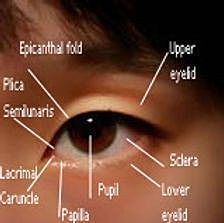 What are some of the characteristics of an Asian eyelid when compared to an occidental eye?
The so called "double lid surgery" is the commonly requested surgery make the eyelid crease a more noticeable trait. This procedure has been analyzed over the years and modified many times over the years.
Fast facts about the double eyelid procedure
Potential complications:One major single surgeon study quoting over 6000 patients in 18 years showed the following complicationsDuring the perioperative period, the patient may have eyelid swelling which may take weeks to months to return to a normal volume. This must be discussed in advance with the patient. Courtesy of www.abagongfileswordpress.comPrinciples of the Asian "double lid surgery"This varies greatly between individuals since the presence of an epicanthal fold or how noticeable the eyelid crease is or isn't to begin with differs from person to person. However the principle can be reduced to addressing two key issues:
Conclusion:In the right hands, this procedure yields fast and satisfying results to the patient. However it must be kept in mind that the immediate appearence postoperatively does not reflect the final outcome, which is true of so many other procedures in cosmetic plastic surgery.Other issues should be recognized, acknowledged and addressed prior to undergoing a blepharoplasty. Amongst these are the presence of asymmetry, eyelid ptosis(droopy eyelid), disfunction or dehiscence of the levator muscle of the eyelid causing droopiness for reasons other than mere excess tissue.Rafael Magana M.D.Guest Blogger, New York Plastic Surgeon
Bibliography1.Aesthetic Plastic Surgery;By Sherrell J Aston, Douglas S Steinbrech and Jennifer Walden Chapter 332.Asian Blepharoplasty: An 18-Year Experience in 6215 Patients; Arthi Kruavit;Aesthetic Surgery Journal 2009 29: 272 DOI: 10.1016/j.asj.2009.04.0043.Anatomic Microstructure of the Upper Eyelid in the Oriental Double Eyelid,Jian Cheng, M.D., and Feng- Zhi Xu, M.D. Plastic & Reconstructive Surgery. 107(7):1665-1668, June 2001.4.A New Crease Fixation Technique for Double Eyelidplasty Using Mini-Flaps Derived from Pretarsal Levator Tissues ;Choi, Yeop; Eo, SuRak;Plastic & Reconstructive Surgery. 126(3):1048-1057, September 2010. doi: 10.1097/PRS.0b013e3181e3b72a5.The Concept of a Glide Zone as It Relates to Upper Lid Crease, Lid Fold, and Application in Upper Blepharoplasty Chen, William Pai-Dei Plastic & Reconstructive Surgery. 119(1):379-386, January 2007.doi: 10.1097/01.prs.0000244908.04694.32